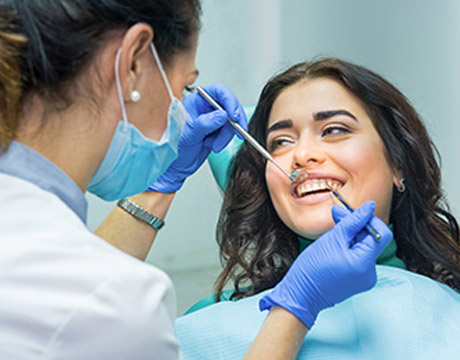
Orthodontic Invisalign in Delhi
Orthodontic Invisalign
Over the past two decades, using clear aligners to realign or straighten your teeth has gained popularity.
The clear aligner product Invisalign, released to the market by Align Technology in 1998, is arguably the oldest and most well-known. However, since then, numerous transparent aligners from different manufacturers have entered the market.
Orthodontic Invisalign: Description
A particular style of thin, transparent aligner used in orthodontic treatment goes by the brand name Invisalign. SmartTrack is a flexible thermoplastic polymer used to make the aligner. According to the American Association of Orthodontists, this device is intended to make orthodontic treatment “less visible,” as the name implies. Even though Invisalign aligners are clear, they fit over your teeth firmly and are considerably less evident than the brackets and wires of conventional braces.Over the past two decades, using clear aligners to realign or straighten your teeth has gained popularity.
The clear aligner product Invisalign, released to the market by Align Technology in 1998, is arguably the oldest and most well-known. However, since then, numerous transparent aligners from different manufacturers have entered the market.
Orthodontic Invisalign: Description
A particular style of thin, transparent aligner used in orthodontic treatment goes by the brand name Invisalign. SmartTrack is a flexible thermoplastic polymer used to make the aligner.
According to the American Association of Orthodontists, this device is intended to make orthodontic treatment “less visible,” as the name implies.
Even though Invisalign aligners are clear, they fit over your teeth firmly and are considerably less evident than the brackets and wires of conventional braces.

Conditions That Can Be Treated by Invisalign
Crowding and spacing difficulties, as well as some mild and moderate biting issues, can all be treated with Invisalign. It can be used to address the following dental conditions:- Various overbite, underbite, and crossbite problems
- Open bite malocclusion
- Teeth gaps
- Teeth crowding
Implications Of Wearing Invisalign
The process begins with a visit to an orthodontist, who will take a 3-D scan of your mouth and jaw as the first step. Then, using this picture as a guide, they’ll devise a strategy for shifting your teeth into their ideal positions. Then, your orthodontist will use that strategy to design a set of plastic aligners that are uniquely yours. Because of the pressure these aligners apply, your teeth will progressively shift and move into the desired positions. You may change out a set of Invisalign for a new set once per week or so, as directed by your orthodontist. The patient should wear the aligners for 20 to 22 hours per day.Efficacy of Invisalign
Some of your friends may have had positive Invisalign experiences, but it’s crucial to look beyond hearsay. Unfortunately, however, there isn’t much evidence for its usefulness. A consultation with your orthodontist will help you determine which options would fit your budget and which might work best for you. Compared to other clear aligner kinds, Invisalign appears more efficient. And the more recent models appear to have improved the effectiveness of Invisalign by more effectively applying force to the wearer’s teeth.Factors That May Impact The Effectiveness Of Invisalign
Wearing the aligners for 20 to 22 hours daily is necessary for Invisalign to function properly. The only circumstances in which you should take off your aligners are:- consuming food or beverages
- tooth brushing or dental flossing
- keeping your aligners clean
Advantages And Complications of Invisalign
Let’s look at the advantages and complications of this orthodontic treatment option so you can decide if Invisalign is the best option for you.Advantages of Invisalign
The element of beauty.
This is a very frequent justification for selecting Invisalign. Compared to the wires and brackets of braces, these clear aligners are far less apparent.You can get rid of them.
If necessary, you can manually take the aligner out of your mouth.Brushing your teeth is simple.
You can simply clean and floss your teeth while wearing an aligner because no wires or brackets can get in the way. This may also enhance periodontal health by lowering the bacteria around your teeth and gums.Fewer possible issues.
Many people with conventional braces have tales of a bracket coming loose or a wire snapping, necessitating an urgent trip to the orthodontist. That potential issue won’t arise if you use clear aligners.Complications with Invisalign
Less successful with difficult problems
Despite its limitations, research from Trusted Source does seem to support the idea that Invisalign works better for patients whose teeth only need specific types of movement. Your doctor might advise a different course of action for more complicated problems. Additionally, Invisalign might not be the best choice if you have bridgework on a few teeth.Demands Adherence
You must use Invisalign for 20 to 22 hours daily to reap its full benefits. It might not be your greatest option if you believe you’ll be tempted to sneak them out more frequently.Need to Remove when consuming food or beverages
You must remove your aligners before eating or drinking. Food or liquid may enter them if you don’t. Cavities may result from the bacteria that grow along your teeth or gums’ gumline because of this. Additionally, they may absorb moisture, discoloring the aligners and your teeth.Food restrictions
When the aligner is taken out, you can have tooth pain, which may restrict what you eat. Particularly hard foods ought to be avoided.Eligibility for Invisalign
If you’re thinking about using Invisalign aligners, consider these factors to help you decide if this is the best option for you:- Do I have a simple crowding or bite problem with my teeth?
- Do I feel embarrassed to have braces on?
- Will I use the aligners for the recommended time each day?
- Could I afford them?
- Will I properly care for them?
FAQ's
Invisalign can straighten teeth without the usage of metal braces. Instead, a series of clear braces created to order called Invisalign covers your teeth and gradually moves them into the right position.
Invisalign aligners are discrete and almost apparent, but they offer efficient treatment with dependable, long-lasting results. In addition, because of the tension, the aligners exert on the entire tooth, Invisalign therapy may occasionally be even more successful than braces.
The ideal candidates for Invisalign may not be people with dental implants, bridges, or TMJ issues. In addition, Invisalign might not work if your teeth are on the tiny side, have irregular shapes, or have deteriorated enamel.
Some people choose Invisalign since they like the concept of removing aligners, while others prefer to concentrate on the idea of a covert orthodontic procedure. However, Invisalign users believe that their treatment's advantages far exceed any disadvantages.
With Invisalign, there is no upper age restriction. However, adults well into their 40s, 50s, and older make up most of those seeking Invisalign's cosmetic and oral health benefits.
1. How Does Invisalign Work?
Invisalign can straighten teeth without the usage of metal braces. Instead, a series of clear braces created to order called Invisalign covers your teeth and gradually moves them into the right position.
2. Is Invisalign more durable than braces?
Invisalign aligners are discrete and almost apparent, but they offer efficient treatment with dependable, long-lasting results. In addition, because of the tension, the aligners exert on the entire tooth, Invisalign therapy may occasionally be even more successful than braces.
3. Who is not eligible for Invisalign treatment?
The ideal candidates for Invisalign may not be people with dental implants, bridges, or TMJ issues. In addition, Invisalign might not work if your teeth are on the tiny side, have irregular shapes, or have deteriorated enamel.
4. Is Invisalign a good investment?
Some people choose Invisalign since they like the concept of removing aligners, while others prefer to concentrate on the idea of a covert orthodontic procedure. However, Invisalign users believe that their treatment’s advantages far exceed any disadvantages.
5. When is Invisalign too late for you?
With Invisalign, there is no upper age restriction. However, adults well into their 40s, 50s, and older make up most of those seeking Invisalign’s cosmetic and oral health benefits.
Regain Your Happy Smile in Healthy Way
Be it a dental checkup, an inquiry about a dental procedure, or correcting your dental issues, we assure quality care and a happy smile with flexibility in appointment scheduling.